Institutions
School and institutional transport
Staff routes, hostel shuttles and excursions, run on tourist-permit vehicles against a written contract. What we do not run is the daily school bus. That is a separate vehicle under a separate rule, with its own livery and its own specification.
- From
- ₹26.00a kilometre in a tempo traveller. Every class and every charge is on the rate card.

What we run for an institution, and what we will not
Set out in the order a purchase committee usually works through it, which starts with scope and ends with the invoice.
Staff routes, hostel shuttles and excursions, and not the daily bus
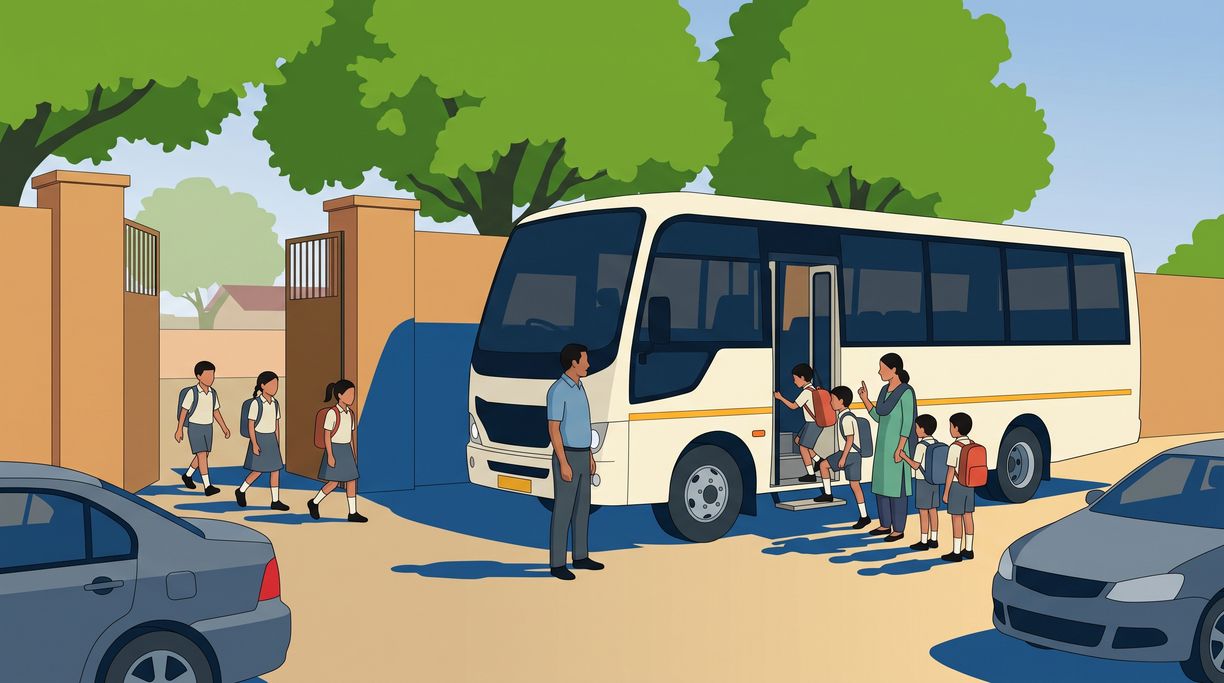
Our vehicles run on tourist permits, and that fixes what they may be used for. A daily school route is not on the list. It is a different vehicle under the school bus specification in the Central Motor Vehicles Rules, with the prescribed livery, the speed governor and the attendant that go with it, and permits written for that job and no other.
So the work we take from a school or a college is the staff route, the hostel shuttle, the departmental run and the excursion. All four are contract carriage work and all four sit inside the permits we hold.
If an operator says yes to the daily route as well as to all four off one set of papers, the useful question is which permit he is holding. It is worth asking before the tender closes rather than after a child is on the vehicle.
The documents that go in your tender file, and the dates on them
Every vehicle on a contract carries a permit, a fitness certificate and an insurance policy, and every driver a licence and a police verification. Those are supplied as documents at the RFP stage rather than described in a sentence on a website, because a sentence on a website is worth nothing in a tender file.
The question worth asking is never whether they exist. It is when each of them runs out and who is watching that date, and the answer belongs in the contract with a name against it.
Part of the fleet is partner operated. Where a partner vehicle is on your route, the same file is supplied for that vehicle and that driver before it runs. How often a verification is refreshed is a term of your contract rather than a house rule of ours, because an institution is entitled to set it higher than the market does.
Who may put a child in a vehicle, and who may take one out
A child does not travel alone without written authorisation from the institution or the guardian, naming the adult receiving the child at the other end. It applies to a hostel drop at the railway station exactly as it applies to an excursion, and we would rather be inconvenient about that than flexible about it.
What a vehicle does at a stop where a child has not come is a contract term and not a driver’s decision: how long it holds, who is rung first, and who answers that phone at half past seven in the morning. It is settled in writing before the route runs.
Nothing about a specific vehicle or a specific driver is published on this website, and that is deliberate rather than evasive. The registration, the model and the man are named in your contract and on the duty slip, where the office can check them against what turned up, rather than on a page anybody can read.
A trip out of the district, and everything it sets off
An excursion is counted gate to gate: out from the institution, wherever it goes, and back to the institution. It is quoted and billed as its own job rather than folded into the month.
Going into the hills sets off most of the charges on the rate card at once, and the quotation names each of them with a figure against it before anybody confirms. The one to plan around is the inter-state permit, which is bought per state per trip for a tempo traveller or a coach and goes on the bill with the receipt behind it.
A fixed figure matters more here than anywhere else on the contract, because an excursion is the trip a parents committee will be asked to approve. Nothing reaches the invoice that was not on the quotation the institution accepted.
A route billed for the month, an excursion billed as its own job
A route is billed monthly with the duty slips behind it. Kilometres past the contracted band are at the published class rate off the odometer, toll and parking at actuals with the receipts, GST on its own line.
A routed contract is counted from the first stop of the morning to the last of the evening. The run from our end to the first stop is ours and it is not on your bill, which is the line most worth checking against whatever else you have been quoted.
One invoice, one set of duty slips, and nothing on either that was not on the quotation you accepted.
Choosing between a fixed route, a point pick-up and a shuttle
These are not tiers and none of them is the better one. They answer different problems, and the fields below are what a purchase committee asks about before it asks the price.
| Fixed route (our usual recommendation)A published list of stops and times, run the same way every working day. | Point pick-upA short list of addresses collected on the way in, set from the actual rider list. | Hostel shuttleA loop between two or three points on a timetable, all day or in bands. | |
|---|---|---|---|
| What it suits | A staff run where most people live along two or three corridors. | A short rider list scattered across the town, or one that changes with the term. | A campus and a hostel a couple of kilometres apart with people moving all day. |
| Who sets the stops | The institution, once, and the list goes into the contract. Adding one is a written change. | The institution each term, from the rider list. Addresses move without the contract moving. | Nobody. Two or three fixed points and a timetable against them. |
| How it is counted | Odometer, first stop of the morning to last of the evening. | Odometer, the same way. The order of the addresses is the driver’s to work out unless you set it. | By the hours the loop is manned, and the kilometres run inside them. |
| When somebody is not there | The vehicle holds to the timetable, because everybody downstream of that stop is waiting on it. | The driver rings the coordinator on the duty sheet before moving on. | Nothing happens. The next loop is along shortly. |
| Vehicle usually put on it | A seventeen seater, or a twenty seven seat mini-bus where the load justifies it. | A twelve or seventeen seater, sized to the list rather than to the route. | A seventeen seater, because the loop is short and the turnover is high. |
| How it is billed | Monthly against the duty slips, kilometres past the band at the published class rate. | Monthly the same way. A term with more addresses in it shows up as kilometres, not as a renegotiation. | Monthly, on the hours the loop was manned. |
| Changing it | A written change to the stop list, and the band is re-checked against it. | Send the new list. Nothing in the contract has to move. | A change of timetable, which is a change of hours. |
A staff run of any size is usually steadier as a fixed route, because a published stop list is what keeps a vehicle on time and a vehicle that is on time is most of the product. A point pick-up earns its cost where the rider list changes every term.
From a staff route to a year group going away
A routed contract and an excursion want different vehicles and the list has to serve both. The tempo traveller is the staff route and the hostel shuttle. The mini coach and the coach are a year group going somewhere.

Tempo traveller
Force Traveller 12/17/25, Force Maharaja 20, Force Urbania 17, or similar
- Seats
- Up to 25
- Per km
- From ₹26.00
Mini coach
Eicher 25/27, or similar
- Seats
- Up to 27
- Per km
- From ₹35.00

Coach
Ashok Leyland, or similar
- Seats
- 35
- Per km
- ₹45.00


Effective . Driver allowance is charged per calendar day and is on the rate card with everything else.
What the fare covers
In the quoted fare
- Fuel and running cost
- Whatever the trip burns.
- The chauffeur
- His driving charges for the duty.
- Maintenance, insurance and air conditioning
- The vehicle is insured and serviced, and the AC runs.
- Vehicles named by class, never by registration
- A class with its typical models and the words or similar. Part of the fleet is partner-operated, so a number plate printed on a website is a promise about one particular car. The contract names what is on your route; the website does not.
- The evening-before message, applied to a route
- On a route contract the useful half is the exception. Whenever tomorrow is not the regular driver, the school office is told the evening before who it is, with his number.
Charged on top
- Kilometres beyond the quoted itinerary
- At the published per kilometre rate for the class, counted from the odometer.
- Toll
- At actuals, and the FASTag statement is shared with the bill.
- Parking
- At actuals, with the receipt.
- State entry tax
- Where the trip crosses a state border. At actuals, and named on the quotation before you confirm.
- Inter-state permit
- For a tempo traveller or a coach crossing a state line. At actuals, with the receipt on the bill.
- Driver allowance₹600 to ₹800 a day
- Per calendar day the car is held, including the day it comes back.
- The driver's night halt
- On a multi-day trip where there is no driver accommodation at the hotel. We tell you before the trip which it will be.
- Hill entry and green tax
- Levied by the local authority on the way in. At actuals, and named on the quotation before you confirm.
- GST5%
- Shown as its own line on the quotation and on the invoice.
A routed contract is counted from the first stop of the morning to the last of the evening, on the odometer, and the run from our end to the first stop is not on your bill. An excursion is counted gate to gate: out from the institution, wherever it goes, and back to the institution. Both readings are on the duty slip and the invoice adds them up.
The figure on your quotation is the figure you pay. Everything payable at actuals is a named line on it, with a number against it, before you confirm. Nothing is added afterwards.
What a principal and a parents committee ask

Will you run our daily school bus?
No. A daily school route is a different vehicle under a different rule: the school-bus specification in the Central Motor Vehicles Rules, the livery, the speed governor and the attendant that go with it, and permits written for that job. Ours are tourist-permit vehicles, so what we run for a school is the staff route, the hostel shuttle and the excursion. If an operator says yes to all four off one permit, ask him which permit.
What checks does a driver on our contract go through?
Papers, and they go into your tender file rather than being described to you: the driving licence, the police verification, and the vehicle permit, fitness certificate and insurance, each with its expiry date on it. Ask for them at the RFP stage and not at signing, because the useful question is never whether they exist, it is when they run out and who is watching that date.
Will you carry a child on their own?
Not without written authorisation from the institution or the guardian, naming the adult who is receiving the child at the other end. We would rather be inconvenient about that than flexible about it, and it applies to a hostel drop at the railway station exactly as it applies to an excursion.
What does a three-day excursion to the hills cost on top of the per-kilometre rate?
Driver allowance for each calendar day the vehicle is held, including the day it comes back. A night halt where the hotel has no room for the driver, and we tell you which it will be before you go. Hill entry and green tax at the barrier in Himachal, Uttarakhand and the Kashmir valley. An inter-state permit per state for a tempo traveller or a coach. Toll and parking at actuals with the receipts, and GST as its own line. Every one of them is a named line with a number against it on the quotation before you confirm, which is the whole reason for asking somebody to write it down.
Is a route contract billed per trip or for the month?
A route is billed for the month, with the duty slips behind it and the extras itemised: kilometres beyond the contracted band at the published class rate, toll and parking at actuals with the receipts, GST on its own line. An excursion is quoted and billed as its own job. Nothing appears on the invoice that was not on the quotation you accepted.
Papers for every vehicle and every driver on a contract, with their expiry dates on them, are supplied at the RFP stage rather than described here. The attendant arrangement, the verification cycle and what a vehicle does at a stop where a child has not come are settled in your contract before the first route runs, and none of the three is left to be decided by a driver on the morning it happens.
Sending an enquiry is not a booking and does not hold a vehicle. We price the trip, send you a fixed all-inclusive figure in writing, and nothing is reserved until you confirm that figure.

Send the routes and the timings. We will price them.
A written quotation with the papers behind it, sized to the stops and the hours you actually run rather than to a standard contract.
Written quotes 9 am to 9 pm, seven days. The line itself is answered at any hour.